Geonode logo

Residential proxies from $0.27/GB
No middleman.

No credits, no multipliers, because we don't have a supplier margin to recoup.

Residential Proxies Pricing

Residential proxy pricing explained

Residential proxy pricing is based on the traffic you use, measured in GB. Geonode residential proxies start at 10 GB for $7.92, or $0.792 per GB, on a monthly plan. The price drops as you buy more traffic and reaches $0.27 per GB at the 100 TB tier.

There are no credits or multipliers. The GB shown in your plan is the traffic you can use.

Pay-as-you-go: what $0.30 per GB includes

The $0.30 rate is the pay-as-you-go price at the 100 TB tier. It includes access to the residential IP pool, location targeting, supported protocols, session controls, and usage statistics.

No monthly minimum, no credits: what that means for a small project

Pay-as-you-go lets a small project buy traffic without a recurring plan. No monthly minimum means you do not need to buy traffic every month.
What “per GB” means and how much traffic a task uses

Residential proxies per GB are billed for data that passes through the proxy. This includes the request and the response. For a normal GET request, the request is usually small, so most bandwidth comes from the response.

Estimated traffic in GB = Number of requests × Average transferred data per request in MB ÷ 1,024

Redirects and retries count because they create extra requests. Include images, scripts, fonts, and other assets only when your browser or scraper downloads them. A scraper that requests HTML only will not use traffic for page images or fonts.

Example: 1,000 HTML pages

1,000 HTML pages × 500 KB = approximately 0.48 GB

It assumes that each HTML page transfers about 500 KB.

Example: 1,000 pages with images

1,000 complete pages with images × 3 MB = approximately 2.93 GB

This estimate includes images and page assets. An HTML-only scraper will use less traffic.

Example: 10,000 API calls

10,000 API calls × 100 KB = approximately 0.95 GB

API responses can be much smaller or larger. Run a small test first and check actual usage in the Geonode dashboard.

Rotating vs sticky sessions: which one to choose

Choose rotating sessions when each request can use a new IP. Choose a sticky session when several requests need the same IP.

Session typeBest fit
RotatingSeparate requests, price checks, and public web data
StickyForms, browsing sessions, and tasks that need continuity

When to rotate on every request

Rotate on every request when one request does not depend on the last one. This works well for price monitoring and public data collection.

When to hold one IP for a session

Use one IP when a task needs continuity, such as a form or browsing session. We support sticky sessions for up to 24 hours, although the IP can change sooner if the residential device goes offline.

Country and city targeting

We have residential IPs in more than 150 countries. You can target country, state, city-level location, ASN, ISP, and operating system when matching IPs are available.

How Geonode compares on entry price

The table shows public residential proxy offers checked on September 18, 2026. Prices, promotions, and taxes can change.

ProviderMinimum purchasePlan typePromotionVATMonthly commitment
Geonode10 GB, $8.80Pay-as-you-go1 TB program for eligible usersNot shownNo monthly minimum
Bright Data$4 per GBPay-as-you-go50% off with RESIGB50Not statedNo commitment
Oxylabs5 GB, $30Monthly planNot shownMay applyYes
IPRoyal1 GB, $7Pay-as-you-go5% off subscriptionsNot statedNo commitment
Decodo3 GB, $11.25Monthly planFree trial shownAdded at checkoutYes

Geonode is cheaper per GB at the listed entry price. This table covers residential products only. It does not compare ISP or datacenter proxy plans.

Who uses residential proxies

Residential proxies help teams view public web data from different locations.

  • A reseller can use web scraping to collect public product details, stock, prices, and reviews. Residential IPs help the request come from the market being checked.
  • Pricing teams can use price intelligence to compare public offers by country. This helps when a store shows different prices in different regions.
  • SEO teams can use search engine crawling to check search results from another city or country. This can reduce location bias from their own connection.
  • Brand teams can use brand protection to review public listings and ads. Residential IPs help them see what people in a selected market may see.

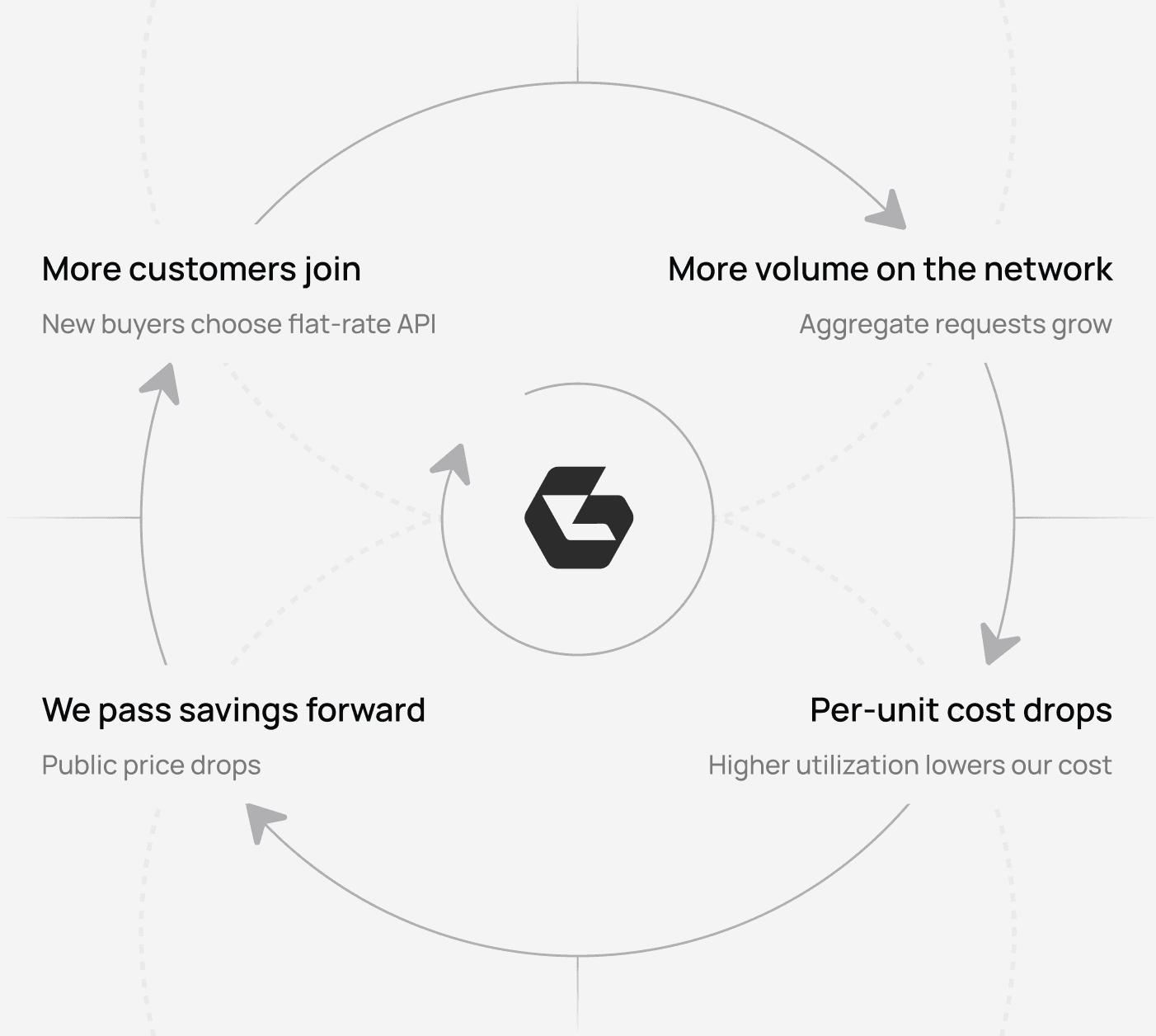
Here's how we offer low prices on world-class quality

Most scraping APIs run on rented supply with credit-based pricing. That's why your bill is unpredictable. We chose the opposite path and the math compounds.

How more customers, operating our own network, wholesale prices, and lower costs reinforce each other

Start using residential proxies in minutes

Create your account

Sign up with your email and get your API key instantly

Sign-up form with email and password fields in the dashboard

Choose location and proxy type

Select country targeting and session mode: rotating or sticky

Gateway country and session type controls in the dashboard

Add the endpoint to your code

Paste the proxy endpoint into your script or automation tool

Proxy endpoint format and connection details

Scale your traffic

Increase bandwidth and concurrency as your workloads grow

Code examples and integration snippets in the dashboard

Code quickstart

Add the Geonode unlimited residential proxy endpoint and route unlimited traffic through your code

import requests

proxies = {
  "http": "http://TYPE-res-USERNAME:PASSWORD@premium-residential.geonode.com:9000",
  "https": "http://TYPE-res-USERNAME:PASSWORD@premium-residential.geonode.com:9000",
}
res = requests.get("http://ip-api.com", proxies=proxies)
print(res.text)

What teams use residential proxies for

From large-scale data collection to real-time monitoring, residential IPs enable reliable access to public web data

Web scraping

Collect product data, pricing, reviews at scale without blocks

Price monitoring

Track competitor pricing across regions in real time

Ad verification

See your ads as real users see them, from real residential IPs

SEO research

Location-accurate SERPs without geo bias

Market research

Public data from any market, any language, 150+ countries.

Why this is different

We operate the network

You buy directly from the network operator, so there's no reseller margin built into your price. Ours keeps falling.

No credit system

No multipliers converting GB into abstract credits. No "rollover" that quietly expires. Your GB is your GB.

We're honest about trade-offs

Our pool is 7.5M+ IPs active monthly, not 150M like Competitors. If you need deep coverage in a niche geography, test it first. We win on price and simplicity. We're growing fast on coverage.

Worldwide residential IP locations and Geonode dashboard with usage, plan, and reseller tools

FAQ

Yes. You can use rotating sessions when you need frequent IP changes or sticky sessions when you need to keep the same IP for a longer period.

Sticky sessions can be configured for up to 24 hours. Since Residential IPs come from live devices, the IP may change earlier if the underlying device goes offline.

Yes. In addition to country targeting, you can target by state, city, ASN/ISP, and operating system where live IPs are available.

Premium Residential Proxies do not have a fixed thread limit. You can run multiple concurrent connections based on your setup and available bandwidth.

Residential Proxies use a dynamic pool of real residential IPs and are ideal for rotation and broad location coverage. Dedicated ISP proxies provide static, dedicated IPv4 addresses when you need a consistent IP.

We support HTTP, HTTPS, SOCKS5 and UDP.

A residential proxy for sale gives access to a changing residential IP pool, not one permanent address. We bill the service by traffic. If you need a fixed address, consider a shared or dedicated ISP proxy.

Yes. The residential proxy free trial is available through our 1 TB program for eligible businesses that expect at least 500 GB of monthly use. Approved users receive 1 TB for seven days.

Run a representative sample and check its traffic in your app dashboard. Then use this formula: Sample traffic ÷ Sample requests × Expected monthly requests = Estimated monthly traffic. For example, if 1,000 requests use 0.5 GB, 20,000 similar requests will use about 10 GB. Update the estimate if page size, retries, or request volume changes.

What would your bill look like at $0.27/GB?

Get Started

Using more than 500 GB monthly? Get your 1TB - on us

Geonode dashboard preview: usage and proxy configuration